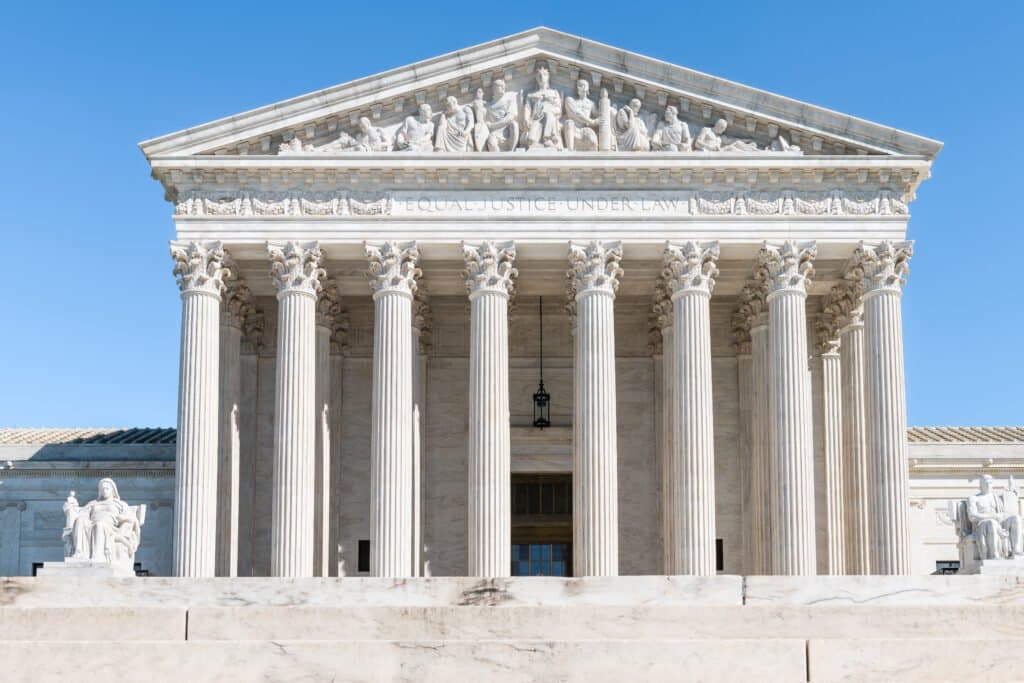
**Escalating federal-state jurisdictional battles over sports event contracts have deepened district court splits without circuit-level resolutions, tempering trader expectations for imminent SCOTUS certiorari.** An Ohio federal judge denied Kalshi a preliminary injunction on March 10, ruling the contracts are not CEA swaps subject to exclusive CFTC oversight but instead state-regulated gambling, prompting a Sixth Circuit appeal; contrasting Tennessee's February grant of relief to Kalshi. Nevada's March 20 temporary restraining order blocking such contracts was upheld by the Ninth Circuit. Today, the U.S. sued Arizona, Connecticut, and Illinois to enforce federal preemption. Absent final appellate rulings creating a clear circuit split—a key certiorari trigger—petitions remain unlikely soon, with pending appeals as the next catalyst.
基於Polymarket數據的AI實驗性摘要 · 更新於$932,027 交易量
7月31日
13%
12月31日
44%
$932,027 交易量
7月31日
13%
12月31日
44%
A case qualifies if it addresses at least one of the following: (1) whether contracts based on sporting event outcomes constitute regulated derivatives under the Commodity Exchange Act; (2) whether federal regulation via the Commodity Futures Trading Commission preempts state-level gambling laws as applied to such contracts; or (3) whether sports event contracts offered by federally licensed markets may legally be offered, restricted, or prohibited by federal or state authorities.
The certiorari grant must be publicly confirmed via the official SCOTUS docket or orders list, and verifiable through credible legal reporting or the Supreme Court’s official website. The case does not need to be heard, scheduled, or decided to qualify.
The resolution source will be a consensus census of credible reporting.
市場開放時間: Jul 16, 2025, 3:36 PM ET
Resolver
0x157Ce2d67...A case qualifies if it addresses at least one of the following: (1) whether contracts based on sporting event outcomes constitute regulated derivatives under the Commodity Exchange Act; (2) whether federal regulation via the Commodity Futures Trading Commission preempts state-level gambling laws as applied to such contracts; or (3) whether sports event contracts offered by federally licensed markets may legally be offered, restricted, or prohibited by federal or state authorities.
The certiorari grant must be publicly confirmed via the official SCOTUS docket or orders list, and verifiable through credible legal reporting or the Supreme Court’s official website. The case does not need to be heard, scheduled, or decided to qualify.
The resolution source will be a consensus census of credible reporting.
Resolver
0x157Ce2d67...**Escalating federal-state jurisdictional battles over sports event contracts have deepened district court splits without circuit-level resolutions, tempering trader expectations for imminent SCOTUS certiorari.** An Ohio federal judge denied Kalshi a preliminary injunction on March 10, ruling the contracts are not CEA swaps subject to exclusive CFTC oversight but instead state-regulated gambling, prompting a Sixth Circuit appeal; contrasting Tennessee's February grant of relief to Kalshi. Nevada's March 20 temporary restraining order blocking such contracts was upheld by the Ninth Circuit. Today, the U.S. sued Arizona, Connecticut, and Illinois to enforce federal preemption. Absent final appellate rulings creating a clear circuit split—a key certiorari trigger—petitions remain unlikely soon, with pending appeals as the next catalyst.
基於Polymarket數據的AI實驗性摘要 · 更新於
警惕外部連結哦。
警惕外部連結哦。
Frequently Asked Questions