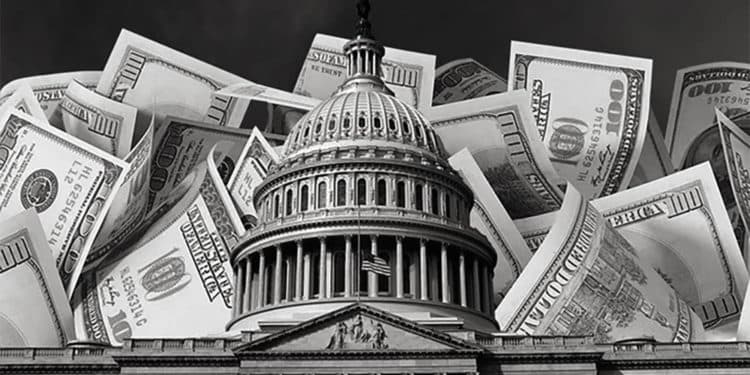
Trader consensus on Polymarket prices a 76% implied probability against a major U.S. bank bailout before 2027, driven by robust regulatory capital buffers across systemically important institutions, where common equity tier 1 (CET1) ratios average over 12%—well above post-stress minimums—and only one small bank failure (Metropolitan Capital Bank & Trust, $19.7 million FDIC cost) recorded in 2026 with no contagion. Recent Federal Reserve finalization of severe 2026 stress test scenarios in February, featuring unemployment peaking at 10%, underscores banks' resilience amid commercial real estate headwinds and $306 billion in sector-wide unrealized losses as of March FDIC data. Private credit redemption gates at BlackRock and others highlight non-bank stresses, but deposit-takers remain insulated. Key catalysts include mid-year stress test results and Q2 economic releases on nonfarm payrolls and CPI trajectory.
Résumé expérimental généré par IA à partir des données Polymarket · Mis à jourUn renflouement majeur des banques américaines avant 2027 ?
Un renflouement majeur des banques américaines avant 2027 ?
Oui
Oui
A bailout is defined as any of these actions in direct response to directly related to solvency, liquidity, or capital adequacy concerns.
-Establishing a Federal Reserve emergency lending facility
-Creating an FDIC-assisted resolution or bridge bank
-A U.S. Treasury capital injection
-A publicly disclosed, regulatory-facilitated acquisition
An official announcement from the U.S. government that they are taking any of these actions will qualify regardless of if/when the action occurs.
Routine access to standing facilities (such as the discount window or BTFP) or participation in stress tests, capital raises, or ordinary supervision will not on their own qualify.
If a bank experiences distress but is acquired privately without public intervention or coordination, this will not qualify.
Marché ouvert : Nov 12, 2025, 6:22 PM ET
Resolver
0x65070BE91...A bailout is defined as any of these actions in direct response to directly related to solvency, liquidity, or capital adequacy concerns.
-Establishing a Federal Reserve emergency lending facility
-Creating an FDIC-assisted resolution or bridge bank
-A U.S. Treasury capital injection
-A publicly disclosed, regulatory-facilitated acquisition
An official announcement from the U.S. government that they are taking any of these actions will qualify regardless of if/when the action occurs.
Routine access to standing facilities (such as the discount window or BTFP) or participation in stress tests, capital raises, or ordinary supervision will not on their own qualify.
If a bank experiences distress but is acquired privately without public intervention or coordination, this will not qualify.
Resolver
0x65070BE91...Trader consensus on Polymarket prices a 76% implied probability against a major U.S. bank bailout before 2027, driven by robust regulatory capital buffers across systemically important institutions, where common equity tier 1 (CET1) ratios average over 12%—well above post-stress minimums—and only one small bank failure (Metropolitan Capital Bank & Trust, $19.7 million FDIC cost) recorded in 2026 with no contagion. Recent Federal Reserve finalization of severe 2026 stress test scenarios in February, featuring unemployment peaking at 10%, underscores banks' resilience amid commercial real estate headwinds and $306 billion in sector-wide unrealized losses as of March FDIC data. Private credit redemption gates at BlackRock and others highlight non-bank stresses, but deposit-takers remain insulated. Key catalysts include mid-year stress test results and Q2 economic releases on nonfarm payrolls and CPI trajectory.
Résumé expérimental généré par IA à partir des données Polymarket · Mis à jour
Méfiez-vous des liens externes.
Méfiez-vous des liens externes.
Questions fréquentes