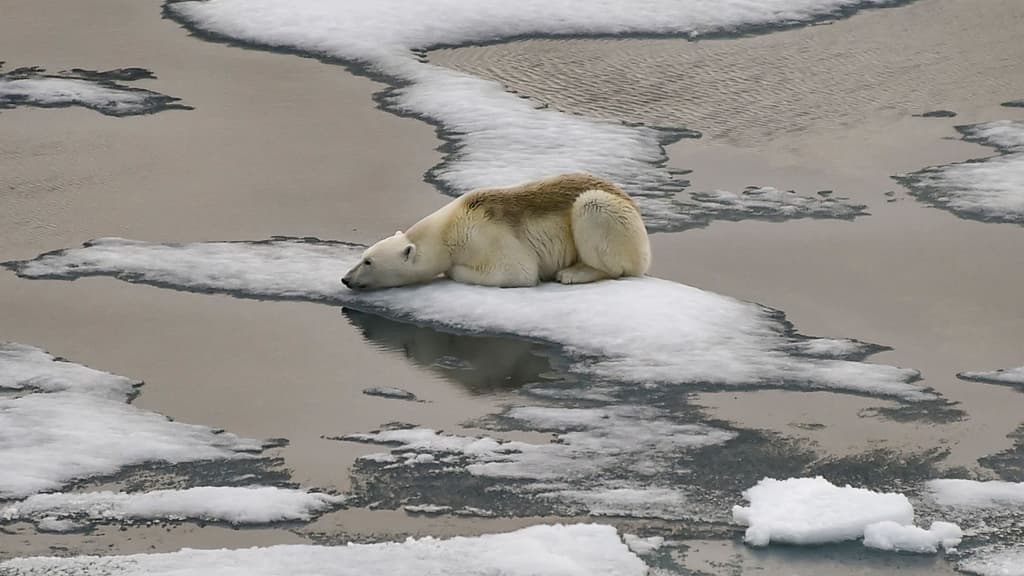
Trader consensus on Polymarket implies a 43% probability for the Arctic sea ice minimum extent this summer falling below 4 million square kilometers, reflecting the record-low winter maximum of 14.29 million square kilometers reached on March 15, 2026—tying 2025's extent and 1.36 million square kilometers below the 1981-2010 average, per National Snow and Ice Data Center (NSIDC) measurements. This stems from anomalously low ice volume and thickness, exacerbated by persistent open water in the Barents Sea that boosted ocean heat absorption and limited refreezing. Thinner, first-year ice is highly susceptible to melt under continued Arctic amplification, though summer atmospheric patterns like high-pressure blocking could moderate losses. NSIDC monthly reports and emerging Sea Ice Prediction Network (SIPN) outlooks in May-June will refine forecasts amid model uncertainties.
Resumo experimental gerado por IA com dados do Polymarket · AtualizadoExtensão mínima do gelo marinho do Ártico neste verão?
Extensão mínima do gelo marinho do Ártico neste verão?
<4 milhões de km² 38%
4,0-4,2 milhões km² 14.5%
4,4-4,6 milhões km² 7.3%
4,2-4,4 milhões km² 5.5%
$29,158 Vol.
$29,158 Vol.
<4 milhões de km²
40%
4,0-4,2 milhões km²
15%
4,2-4,4 milhões km²
8%
4,4-4,6 milhões km²
10%
4,6-4,8m km²
6%
4,8-5 milhões km²
24%
5 milhões+ km²
1%
<4 milhões de km² 38%
4,0-4,2 milhões km² 14.5%
4,4-4,6 milhões km² 7.3%
4,2-4,4 milhões km² 5.5%
$29,158 Vol.
$29,158 Vol.
<4 milhões de km²
40%
4,0-4,2 milhões km²
15%
4,2-4,4 milhões km²
8%
4,4-4,6 milhões km²
10%
4,6-4,8m km²
6%
4,8-5 milhões km²
24%
5 milhões+ km²
1%
This market will remain open until data has been published for October 1, 2026, at which point it will resolve immediately. Any revisions to sea ice extent recorded after data is published for October 1, 2026 will not be considered.
The resolution source for this market measures temperatures to thousands of square kilometers (e.g. 4.255 million sq km). Thus, this is the level of precision that will be used when resolving the market.
The resolution source for this market will be information from the National Snow and Ice Data Center, specifically the minimum value recorded for any day between August 1, 2026 and October 1, 2026 in the “NH-Daily-Extent” tab of the “Sea Ice Index Daily Extent” data set, available at https://nsidc.org/sea-ice-today/sea-ice-tools. If this resolution source becomes unavailable, another resolution source will be chosen.
Mercado Aberto: Nov 20, 2025, 6:43 PM ET
Resolver
0x2F5e3684c...This market will remain open until data has been published for October 1, 2026, at which point it will resolve immediately. Any revisions to sea ice extent recorded after data is published for October 1, 2026 will not be considered.
The resolution source for this market measures temperatures to thousands of square kilometers (e.g. 4.255 million sq km). Thus, this is the level of precision that will be used when resolving the market.
The resolution source for this market will be information from the National Snow and Ice Data Center, specifically the minimum value recorded for any day between August 1, 2026 and October 1, 2026 in the “NH-Daily-Extent” tab of the “Sea Ice Index Daily Extent” data set, available at https://nsidc.org/sea-ice-today/sea-ice-tools. If this resolution source becomes unavailable, another resolution source will be chosen.
Resolver
0x2F5e3684c...Trader consensus on Polymarket implies a 43% probability for the Arctic sea ice minimum extent this summer falling below 4 million square kilometers, reflecting the record-low winter maximum of 14.29 million square kilometers reached on March 15, 2026—tying 2025's extent and 1.36 million square kilometers below the 1981-2010 average, per National Snow and Ice Data Center (NSIDC) measurements. This stems from anomalously low ice volume and thickness, exacerbated by persistent open water in the Barents Sea that boosted ocean heat absorption and limited refreezing. Thinner, first-year ice is highly susceptible to melt under continued Arctic amplification, though summer atmospheric patterns like high-pressure blocking could moderate losses. NSIDC monthly reports and emerging Sea Ice Prediction Network (SIPN) outlooks in May-June will refine forecasts amid model uncertainties.
Resumo experimental gerado por IA com dados do Polymarket · Atualizado
Cuidado com os links externos.
Cuidado com os links externos.
Frequently Asked Questions