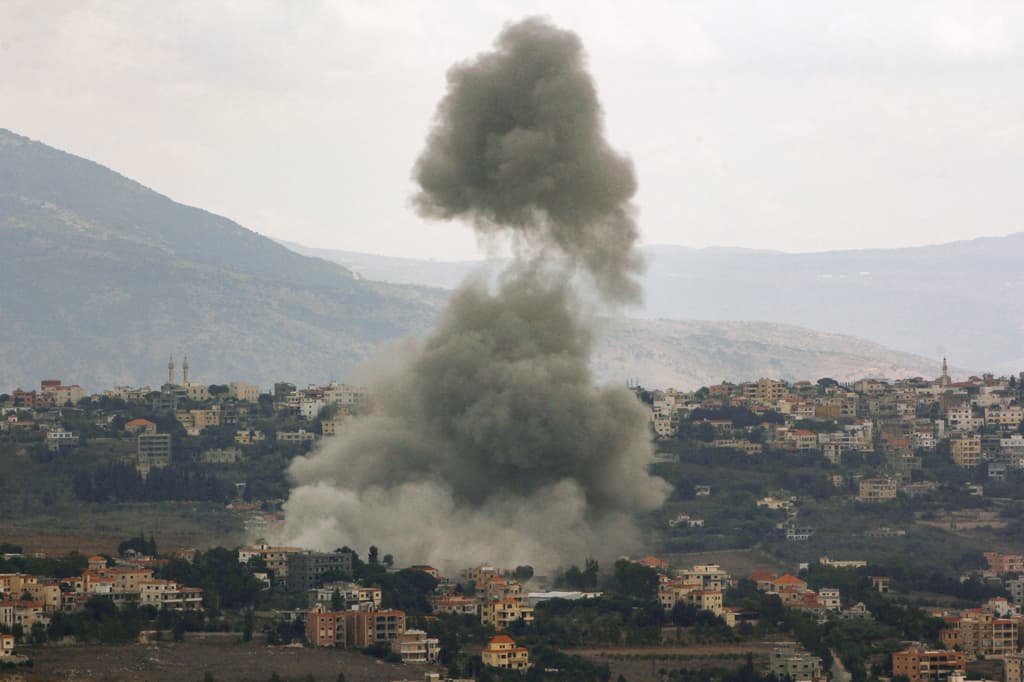
Israeli airstrikes targeted Hezbollah infrastructure in Beirut's southern suburbs on March 27, prompting evacuations and billowing smoke over the capital, as part of an intensified campaign now nearly four weeks old. The escalation began March 2 when Hezbollah fired rockets into Israel following the U.S.-Israeli assassination of Iran's Supreme Leader Ayatollah Ali Khamenei, prompting Israeli retaliation with over 600 strikes across Lebanon, ground operations in the south since March 16, and plans for a buffer zone up to the Litani River. Over 1,000 Lebanese have been killed and more than one million displaced amid fears of wider invasion, while growing domestic Israeli opposition questions the strategy. Traders eye upcoming troop expansions and diplomatic signals for shifts in northern front hostilities.
Resumen experimental generado por IA con datos de Polymarket · Actualizado¿Acción militar de Israel contra Beirut el...?
¿Acción militar de Israel contra Beirut el...?
$93,912 Vol.
March 24
77%
March 26
6%
March 28
72%
March 29
69%
March 30
57%
March 31
70%
$93,912 Vol.
March 24
77%
March 26
6%
March 28
72%
March 29
69%
March 30
57%
March 31
70%
For the purposes of this market, a qualifying "strike" is defined as the use of aerial bombs, drones, or missiles (including cruise or ballistic missiles) launched by Israeli military forces that impact within Greater Beirut.
For the purposes of this market, “Greater Beirut” refers to the continuous urbanized zone that encompasses all of the Beirut Governorate and the adjacent coastal and suburban municipalities of the Mount Lebanon Governorate. For this market, the geographic boundaries as defined in the map “Location of the Greater Beirut Area” (https://polymarket-upload.s3.us-east-2.amazonaws.com/Beirut-3ffb23044f.png) from Faour & Mhawej (2014), Mapping Urban Transitions in the Greater Beirut Area Using Different Space Platforms (https://www.mdpi.com/2073-445X/3/3/941) will be used. If the precise location of a strike cannot be clearly attributed to the defined territory based on the referenced map, it will not qualify.
Missiles or drones that are intercepted and surface-to-air missile strikes will not be sufficient for a "Yes" resolution, regardless of whether they land on the specified territory or cause damage.
Actions such as artillery fire, small arms fire, FPV or ground based ATGM strikes, ground incursions, naval shelling, cyberattacks, or other operations conducted by Israeli ground operatives will not qualify.
The primary resolution source will be official government/military statements (Israeli or foreign), multilateral bodies (UN, etc.), or a consensus of credible reporting from major international media and national broadcasters/newspapers.
If the date/time of a strike cannot be confirmed by a consensus of credible reporting by the end of the third calendar date after this market's end date, it will resolve to "No" regardless of whether a strike was later confirmed to have taken place.
Mercado abierto: Mar 17, 2026, 8:03 PM ET
Resolver
0x65070BE91...Resultado propuesto: Yes
Sin disputa
Resultado final: Yes
For the purposes of this market, a qualifying "strike" is defined as the use of aerial bombs, drones, or missiles (including cruise or ballistic missiles) launched by Israeli military forces that impact within Greater Beirut.
For the purposes of this market, “Greater Beirut” refers to the continuous urbanized zone that encompasses all of the Beirut Governorate and the adjacent coastal and suburban municipalities of the Mount Lebanon Governorate. For this market, the geographic boundaries as defined in the map “Location of the Greater Beirut Area” (https://polymarket-upload.s3.us-east-2.amazonaws.com/Beirut-3ffb23044f.png) from Faour & Mhawej (2014), Mapping Urban Transitions in the Greater Beirut Area Using Different Space Platforms (https://www.mdpi.com/2073-445X/3/3/941) will be used. If the precise location of a strike cannot be clearly attributed to the defined territory based on the referenced map, it will not qualify.
Missiles or drones that are intercepted and surface-to-air missile strikes will not be sufficient for a "Yes" resolution, regardless of whether they land on the specified territory or cause damage.
Actions such as artillery fire, small arms fire, FPV or ground based ATGM strikes, ground incursions, naval shelling, cyberattacks, or other operations conducted by Israeli ground operatives will not qualify.
The primary resolution source will be official government/military statements (Israeli or foreign), multilateral bodies (UN, etc.), or a consensus of credible reporting from major international media and national broadcasters/newspapers.
If the date/time of a strike cannot be confirmed by a consensus of credible reporting by the end of the third calendar date after this market's end date, it will resolve to "No" regardless of whether a strike was later confirmed to have taken place.
Resolver
0x65070BE91...Resultado propuesto: Yes
Sin disputa
Resultado final: Yes
Israeli airstrikes targeted Hezbollah infrastructure in Beirut's southern suburbs on March 27, prompting evacuations and billowing smoke over the capital, as part of an intensified campaign now nearly four weeks old. The escalation began March 2 when Hezbollah fired rockets into Israel following the U.S.-Israeli assassination of Iran's Supreme Leader Ayatollah Ali Khamenei, prompting Israeli retaliation with over 600 strikes across Lebanon, ground operations in the south since March 16, and plans for a buffer zone up to the Litani River. Over 1,000 Lebanese have been killed and more than one million displaced amid fears of wider invasion, while growing domestic Israeli opposition questions the strategy. Traders eye upcoming troop expansions and diplomatic signals for shifts in northern front hostilities.
Resumen experimental generado por IA con datos de Polymarket · Actualizado
Cuidado con los enlaces externos.
Cuidado con los enlaces externos.
Preguntas frecuentes